
Easol alternative for 2026: the real fee maths, line by line

If you are looking for an Easol alternative, start with the whole fee stack. A headline percentage does not tell a retreat host what a platform will actually cost. You need to account for the subscription, revenue or transaction fees, payment processing, fixed charges and any applicable tax. Then you need to ask a second question: does the platform fit the way you sell and run retreats? For independent hosts and smaller retreat centres, both parts matter. A lower-looking fee can become less attractive if the booking workflow still needs separate tools, manual work or compromises around rooms and guest details.
What does Easol actually cost in 2026?
Easol publishes a starting subscription and revenue fee, but those figures are not the complete cost. Its Stride plan starts at $250 per month and Easol fees start from 2% of revenue, while payment-processing fees and some commercial terms vary according to the customer’s plan or agreement. That means your own contract matters. Easol’s pricing page is the starting point, not the final calculation.
Easol subscription fee
The published starting point for Easol Stride is $250 per month. On a simple twelve-month basis, that starting subscription alone would equal $3,000 per year. That figure still does not include percentage-based Easol fees, payment processing or any other applicable charges.
Revenue and transaction fees
Easol says its fees start from 2% of revenue. The phrase “starting from” matters. It means a host should not assume that 2% is necessarily the exact percentage applying to their business. Check the rate stated in your agreement before comparing it with another platform.
Payment processing
Payment processing is another part of the cost stack. Easol says applicable transaction and processing rates are agreed when a business moves onto the platform. That makes it unsafe to plug a generic processing percentage into a comparison and present the result as an all-in Easol fee.
Other charges to check
Processing is not the only additional line to review. Easol’s documentation also refers to fixed per-transaction fees and applicable VAT on its fees. For UK and EU businesses, VAT treatment may depend on the business and its VAT details. The practical lesson is simple: read the statement and agreement line by line before deciding what Easol costs you.
The real Easol fee maths, line by line
The safest way to calculate Easol’s effective cost is to add each known component separately: subscription, percentage-based fees, payment processing, fixed transaction charges and applicable tax. Easol’s own financial-statement documentation defines total Easol fees using several of these components, which is why compressing everything into one assumed percentage can produce a misleading comparison. Easol’s financial statement guide explains the structure.
Total platform cost = subscription + transaction or revenue fee + payment-processing fee + fixed transaction fee + applicable tax
Some of those numbers may be known from public pricing. Others may only appear in your contract or financial statements. Keep that distinction visible. If Easol publishes a starting 2% revenue fee but your processing rate is contract-specific, calculate the 2% component and leave processing as a separate variable until you know the real number.
Easol also says payment-processing rates vary according to the customer’s plan and distinguishes between standard and premium transactions. Cross-border payments can introduce further costs. Its documentation says that where the payment currency differs from the business’s home currency, a 3.5% mark-up is added to the end customer’s price to cover foreign-exchange costs and risk. Those details may or may not apply to your bookings, but they are exactly why the line-by-line method is more useful than a single headline rate.
Why percentage fees matter on higher-value retreat bookings
Percentage-based charges scale directly with booking value. A 2% fee may look modest in isolation, but retreat bookings can be worth thousands rather than tens of pounds. As the booking value rises, the cash amount attached to the same percentage rises with it. The same effect becomes clearer again when you look at annual sales instead of one transaction.
A £2,000 retreat booking
Take a £2,000 booking as a simple illustration. A 2% revenue fee on that booking is £40. That calculation includes only the known 2% component. It does not include payment processing, a fixed transaction charge, subscription costs or tax because those figures cannot be safely assumed from one public headline rate.
Now imagine the same host sells ten £2,000 bookings. The 2% component alone becomes £400. Fifty equivalent bookings would make that component £2,000. The percentage has not changed, but the amount paid has grown alongside revenue.
Annual sales matter more than the headline rate
The same logic applies across a year. At £100,000 in annual sales, a 2% percentage fee represents £2,000. At £250,000, it represents £5,000. These are illustrations of the percentage calculation only, not estimates of an Easol customer’s total bill.
This is why a serious Easol alternative comparison should use your own annual booking value and booking mix. Higher-value retreats can make small differences in percentage fees meaningful. At the same time, percentage cost is only one part of the commercial decision. Subscription levels, processing terms and the actual work the software replaces also matter.
Easol vs Gather: how the pricing models compare
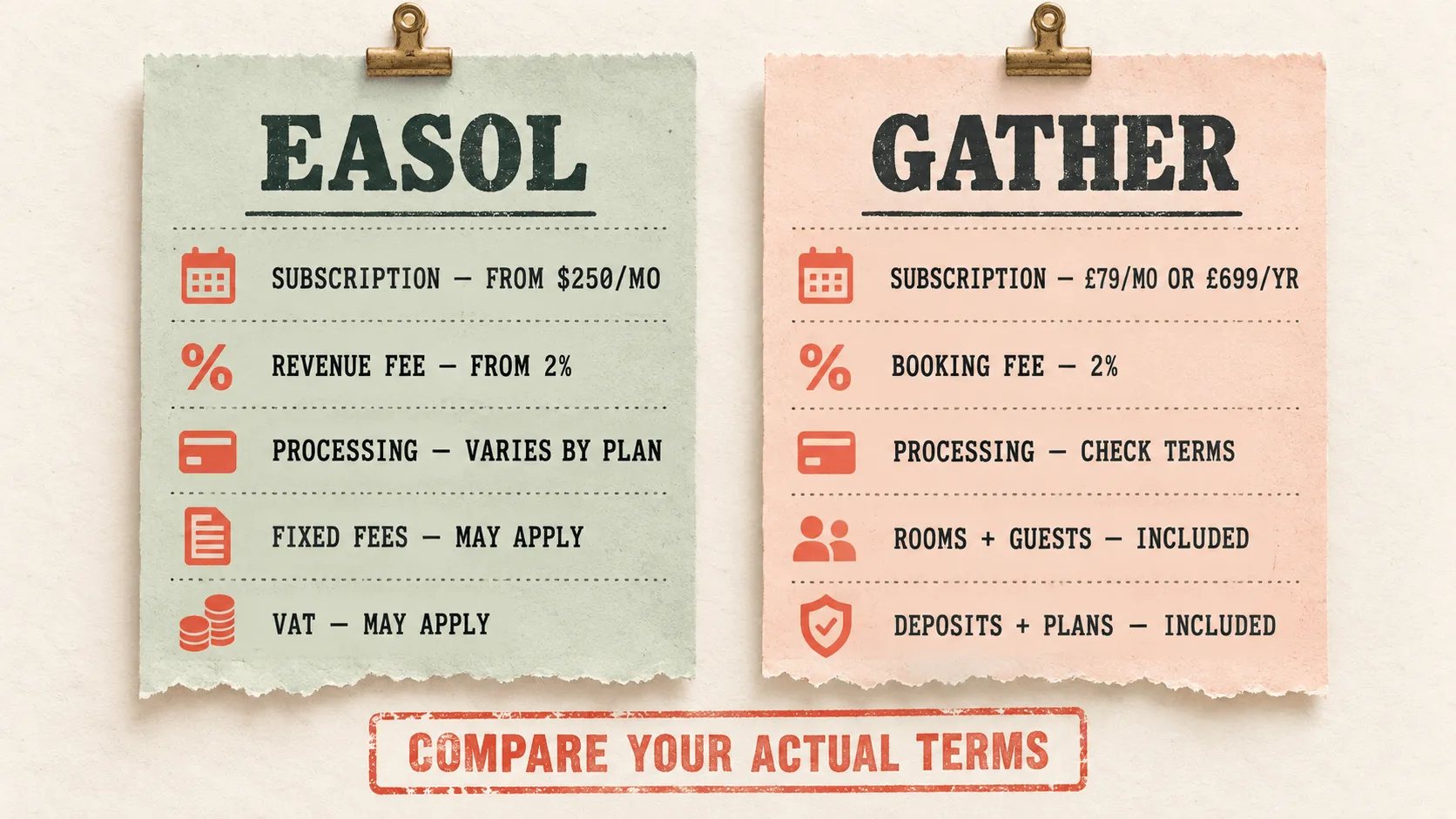
Once the Easol fee stack is clear, the Gather comparison becomes simpler. Gather pricing publishes Software at £79 per month or £699 per year, plus 2% per booking. The annual price works out at £58.25 per month on the published maths. GBP, EUR and USD are supported, and commercial rates are confirmed in writing before signing.

Attribute | Easol | Gather |
|---|---|---|
Subscription | Stride starts at $250/month | £79/month or £699/year |
Percentage fee | Easol fees start from 2% of revenue | 2% per booking |
Payment processing | Separate, with rates varying by plan | No processing figure supplied in the approved source material |
Fixed transaction charges | May apply. Check your statement or agreement | No additional fixed-charge figure supplied in the approved source material |
Tax on platform fees | VAT may apply for UK and EU businesses where applicable | No tax figure supplied in the approved source material |
Rooms | Compare against your actual retreat-room requirements | Shared and private rooms, multiple dates and occupancy-based pricing |
Deposits and payment plans | Supported | Supported |
Guest management and waivers | Compare your current Easol setup | Included in Gather Software |
The table is a decision aid, not proof that one platform will always cost less. Easol terms can vary, while your own booking values and transaction mix affect the result. Put your actual Easol agreement next to Gather’s published model and calculate from those numbers.
Price is only half the Easol alternative decision
An Easol alternative also needs to handle the way your retreats are actually sold and operated. For Gather, the verified workflow covers retreat dates, shared and private rooms, bookings, deposits, payment plans, waivers, guest intake and guest management in one branded platform. The question is not just “what percentage do I pay?” It is “what work does this system handle for me?”
Rooms and occupancy
Retreat accommodation rarely behaves like a simple ticket. You may have private rooms, shared rooms, different occupancy prices and several retreat dates running through the same year. Gather’s room booking tools support shared and private room inventory, multiple dates, occupancy-based pricing, sold and remaining spaces, and guest details in one place.
Deposits and payment plans
High-value retreats often need more than a pay-in-full button. Gather supports deposits and payment plans as part of its booking flow. Easol also supports deposits and automatic or manual instalment plans, so this is an area where hosts should compare the exact setup they use rather than assume the functionality is unique to either platform.
Waivers and guest details
Payment is only the start of the booking. Hosts may also need signed waivers, guest intake information, trip documents and balance information. Gather’s retreat booking software brings bookings, payments, guest management, waivers and guest intake together, with a guest portal for forms, documents and balances.

Your website and brand
The booking flow also sits inside the wider customer journey. Gather can build the host a website on their own domain with dates, rooms, bookings and payments built in. Hosts that want to keep an existing website can also attach Gather for bookings and payments. For an independent retreat business, that flexibility can matter as much as a small difference in transaction cost.
When switching from Easol may not make sense
A simpler-looking or lower-looking fee is not automatically a reason to leave Easol. Switching has its own cost in time, setup and disruption. Before moving, compare your current contract, the functions you actively depend on, the commercial terms Easol has given you and the work required to transfer the parts of your booking operation that matter.
If your existing setup works well, your negotiated fees suit your business and the features you rely on are difficult to replace, staying may be the more sensible decision. A platform comparison should improve the business, not create a migration project simply to chase a percentage point.
Likewise, do not compare public list prices with a private negotiated contract as if they were the same thing. Use your real numbers. Include the subscription, percentage charges, processing, fixed fees and applicable tax on the Easol side, then compare equivalent costs and functionality on the alternative.
What to ask any Easol alternative before you switch
Before switching, ask for enough detail to calculate the total cost and understand the operational change. You need more than a monthly price. Confirm percentage fees, payment-processing rates, fixed charges, payout timing, room handling, deposits, payment plans, waivers, guest data, website ownership and what happens to your information if you later leave the platform.
What is the full subscription cost over a year?
What percentage fee applies to each booking or to revenue?
What payment-processing rate applies to your business and currencies?
Are there fixed transaction charges or applicable taxes on platform fees?
When are funds paid out?
Can guests choose shared and private rooms with the pricing structure you use?
Can you take deposits and offer payment plans?
Can waivers and guest details be collected inside the booking flow?
Who controls the website, domain and customer relationship?
How will active bookings, room inventory and guest information be handled during a move?
Payout timing is worth checking specifically. Easol says payouts are issued weekly on Fridays after platform and processing fees are deducted, and its bank-verification documentation states a minimum payout balance of £100. Cash-flow timing can matter to a retreat operator paying venues, suppliers and facilitators before a retreat runs.
A simpler alternative for retreat hosts
After you have compared the fee stack, come back to the bigger question: does the setup fit how you sell retreats? Gather Software is built for independent retreat hosts and smaller centres that have outgrown forms, payment links and spreadsheets. It brings the branded website, dates, rooms, bookings, deposits, payment plans, guest details and waivers into one place, without trying to be hotel-scale property management.
Compare your current Easol setup and real fee structure against Gather’s published model, then Book a call to confirm fit and commercial terms.
Frequently Asked Questions
See where you are leaving bookings on the table
Book a call and we will tell you honestly whether Gather fits, and what to use if it does not.