
How to Price a Retreat: Costs, Profit Margins and a Simple Formula

If you are working out how to price a retreat, start with three numbers: real costs, realistic paying attendance and required profit. Competitor prices can sense-check the result later, but they should not decide the maths.
Add fixed costs, total variable costs and target profit, then divide that required revenue by expected paying guests. Test the result against lower occupancy, room mix and the market before publishing it.
Start with this simple retreat pricing formula
Your starting retreat price per guest is: (fixed costs + total variable costs + target profit) ÷ expected paying guests. This gives you the average amount each paid place needs to contribute. It is a starting point, not automatically the final advertised price, because room mix, occupancy and market positioning may still change the final numbers.
If costs at expected attendance are £12,000 and you want £4,000 profit, required revenue is £16,000. With 12 paying guests, the average starting price is about £1,333. Then distribute that revenue across room types.
Calculate the true cost of running your retreat
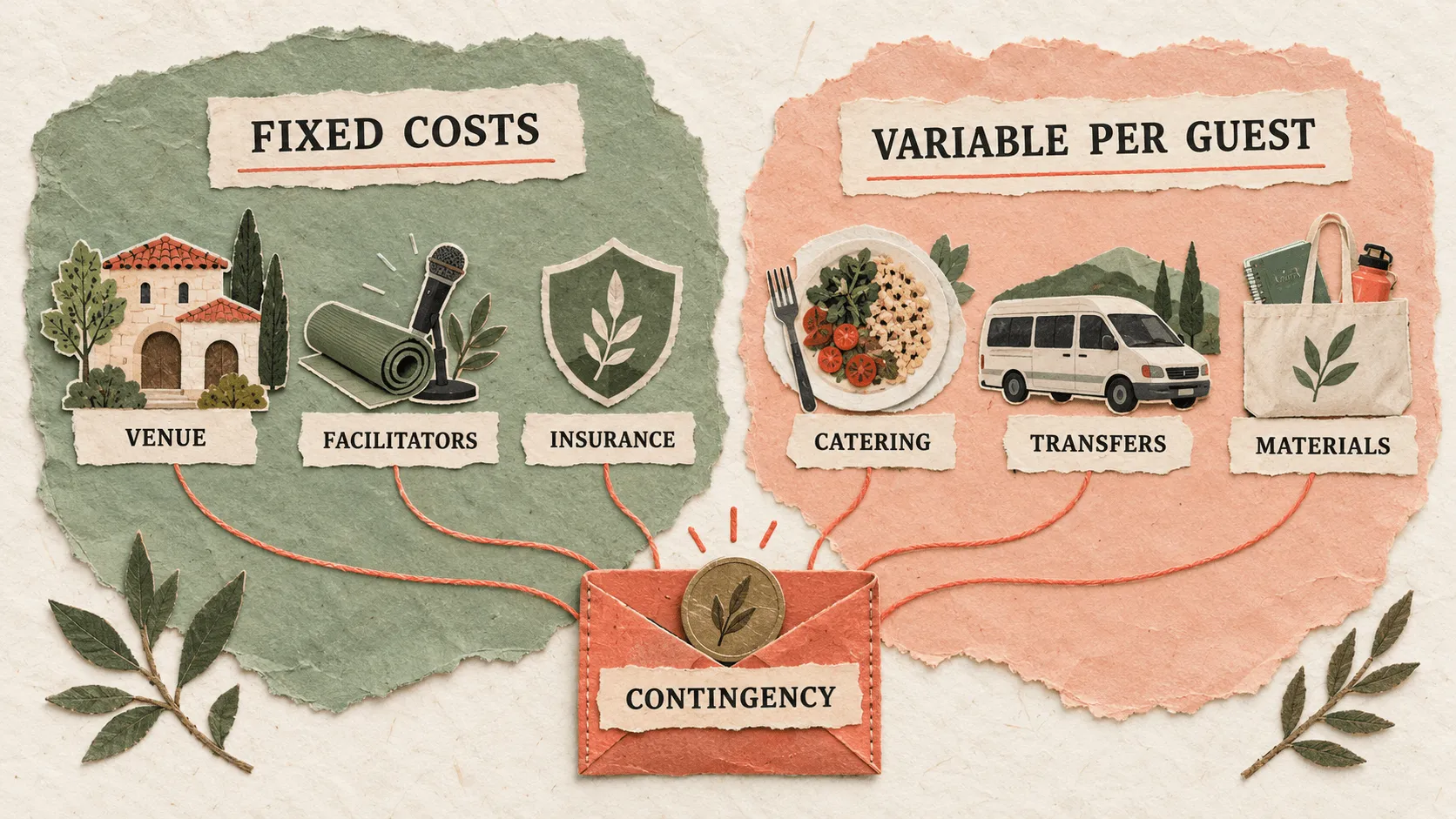
Separate retreat costs into fixed and variable categories before setting a price. Fixed costs stay relatively stable; variable costs rise with attendance. Include host and facilitator compensation plus a sensible contingency. Retreat pricing guidance uses the same distinction.
Fixed retreat costs
These can include venue commitments, facilitator fees agreed in advance and insurance, including costs you may still carry whether eight guests attend or twelve.
Variable cost per guest
Meals, transfers, materials and some guest services change with attendance. Calculate them per guest, then multiply by expected attendance.
Host and facilitator compensation
Your own compensation should not be whatever remains after everyone else is paid. Treat host and facilitator pay as a deliberate cost input. Profit-first retreat planning uses the same principle.
Contingency and overlooked costs
Check payment costs, transport, supplies, dietary requirements and other retreat-specific items. A sensible contingency can protect planned profit from small cost changes.
Price for realistic occupancy, not a sold-out retreat
Build your price around a realistic number of paying guests, not the maximum your venue can hold. A price that only works at 100% occupancy is fragile. Calculate the economics at expected attendance, then separately identify the minimum booking level at which the retreat still covers its costs.
Expected paying guests
Use a number grounded in your retreat history, audience and sales confidence. Maximum capacity is what is physically possible. Expected attendance is what the pricing model should support.
Maximum capacity vs realistic occupancy
If the venue holds 16 people but you expect 12 paid bookings, price from 12. Treat the other four places as upside.
How to calculate your break-even point
Your break-even point is the attendance level where revenue covers the costs generated at that guest count, with no profit left over. Compare revenue and total costs at each likely occupancy level. Keep this separate from both target attendance and maximum capacity.
Add your target profit to the retreat price
Profit should be planned, not treated as whatever remains. Add the required profit to total costs, then divide the revenue target across realistic paid attendance. For a target margin, use the margin formula rather than simply adding that percentage to cost.
Profit amount vs profit margin
If total costs are £12,000 and you want £4,000 profit, required revenue is £16,000. A percentage margin works differently because the percentage is measured against revenue, not cost.
Markup is not the same as margin
Markup measures how much you add above cost. Margin measures profit as a share of revenue. Add 25% to £12,000 of cost and revenue becomes £15,000. The £3,000 profit is a 20% margin, not 25%.
Formula for a target profit margin
Use: Required revenue = total costs ÷ (1 − target margin). With £12,000 of costs and a 25% target margin, required revenue is £16,000. That is the figure you distribute across expected paying guests and room types.
How to calculate your retreat profit margin
Use two calculations: Profit = revenue − total costs, then Profit margin = profit ÷ revenue × 100. QuickBooks' profit formula guidance uses the same distinction between profit, revenue and margin.
With £16,000 of revenue and £12,000 of costs, profit is £4,000. Divide £4,000 by £16,000 and multiply by 100, and the profit margin is 25%.
There is no universal margin every retreat should aim for. Your target depends on your costs, risk, business goals and market. The useful question is whether the margin is intentional and whether the resulting guest price is commercially realistic.
Adjust retreat pricing for private and shared rooms
Once you know required revenue, distribute it across room categories. Private rooms can carry a premium and shared rooms can sit lower, but the combined room mix still needs to hit the same revenue target.
Shared room pricing
Shared rooms can carry a lower per-person price. The important question is whether the revenue from those places still supports the retreat's overall target.
Private room supplements
Private rooms can support a higher price because one guest receives the full room. Set the premium deliberately rather than applying a random uplift.
Keeping the total revenue target intact
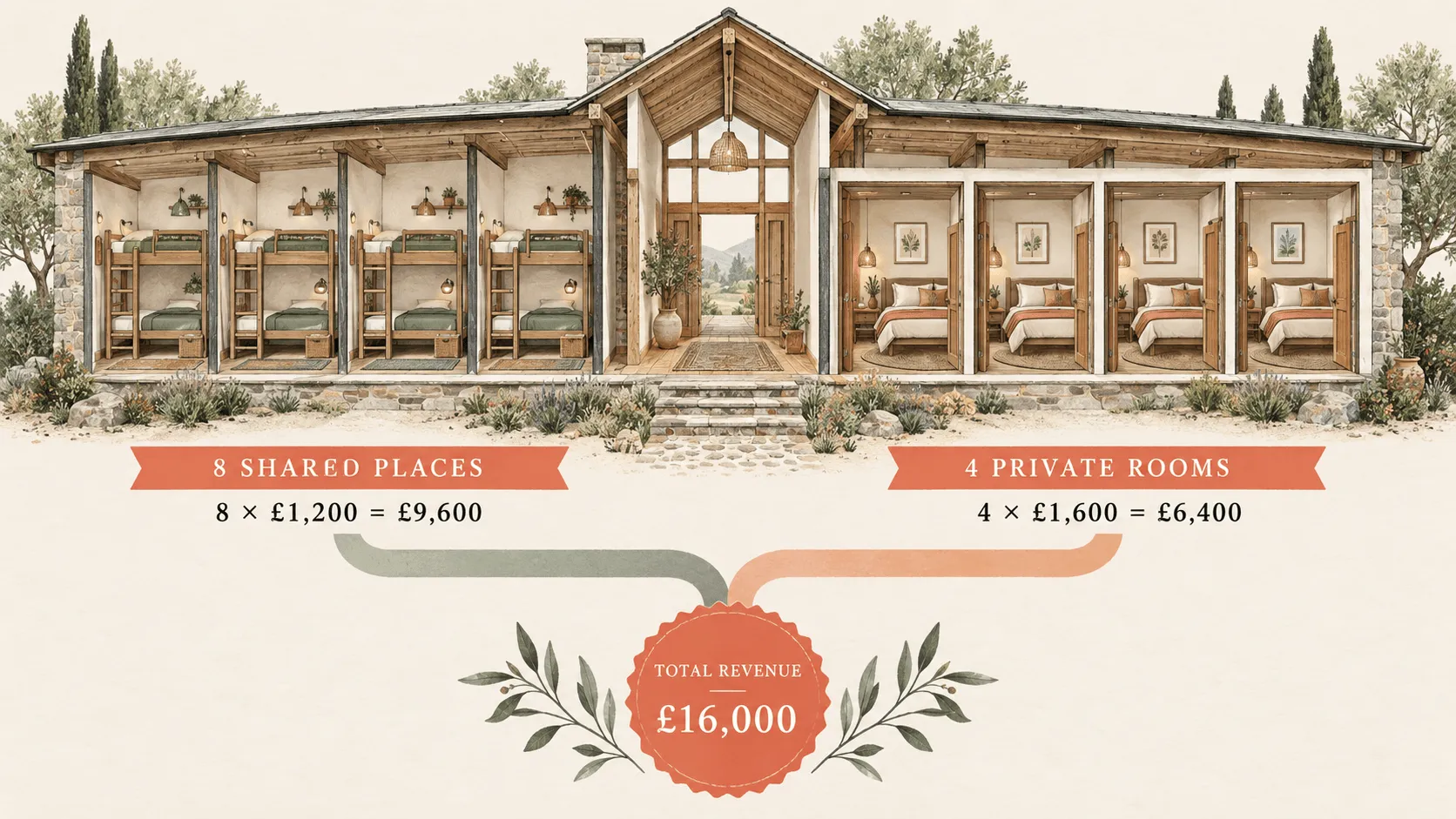
If the retreat needs £16,000 from 12 guests, one hypothetical mix is eight shared-room places at £1,200 and four private-room places at £1,600. That produces £9,600 plus £6,400, reaching the £16,000 target. Gather's room pricing and inventory can keep shared and private options tied to the relevant retreat date and remaining spaces.
Stress-test your retreat price before publishing it
Test what happens if attendance falls, costs rise or the room mix changes. Recalculate before publishing. Only after the economics still work should competitor pricing become a sense-check.
Test lower occupancy
Run the model at one or two lower attendance levels, updating revenue and variable costs. Check whether the retreat still covers costs.
Add a cost buffer
Review the costs most likely to move before delivery and include a sensible buffer where venue extras, transport, food or supplies are uncertain.
Compare the final number with the market
Compare with similar retreats serving a similar audience. Use competitor pricing to sense-check positioning, not copy a number built on unknown costs and occupancy assumptions.
Decide whether the offer needs changing before cutting the price
If the price feels too high, review the offer before discounting. A different venue, programme, inclusions or room mix may improve the economics.
Use this simple retreat pricing calculator
Use the same worksheet each time to see required revenue, starting price per guest and the effect of occupancy changes.
Step | Calculation |
|---|---|
1 | Fixed costs |
2 | + Variable cost per guest × expected guests |
3 | + Target profit |
4 | = Required retreat revenue |
5 | Required retreat revenue ÷ expected paying guests |
6 | = Starting price per guest |
Then calculate expected profit margin and test lower guest counts to find where revenue no longer covers total costs. If you have private and shared rooms, replace the single average price with a room mix that still reaches the same required revenue.
Common retreat pricing mistakes
The biggest mistakes usually come from the assumptions underneath the number, not the arithmetic itself.
Pricing from maximum capacity instead of realistic paid attendance.
Leaving host or facilitator compensation out of the cost base.
Confusing markup with profit margin.
Copying competitor prices without knowing their economics.
Discounting without recalculating the revenue the rest of the retreat must generate.
A repeatable process makes these problems easier to spot before sales open. The price needs to support the retreat you are actually planning to run.
Turn your retreat pricing into a bookable system
Once the numbers work, the next job is making sure guests can book the right room, pay the right amount and follow the payment schedule without creating more manual work for the host. Gather retreat booking software lets independent hosts and smaller retreat centres put dates, room types, pricing, deposits, payment plans, waivers and guest details into one branded booking flow on their own website. For the commercial model, see Gather pricing.
If your retreat pricing is clear but the booking process still feels stitched together, Book a call.
Frequently Asked Questions
See where you are leaving bookings on the table
Book a call and we will tell you honestly whether Gather fits, and what to use if it does not.