
Retreat Deposits, Payment Plans and Cancellation Policies: A Host’s Guide

A good retreat deposit policy is not just a sentence about how much someone pays at booking. It should connect the deposit, payment plan, cancellation windows and refund rules to the real financial commitments behind your retreat.
There is no single percentage or cancellation schedule that works for every host. Your venue terms, supplier deadlines, accommodation commitments and payment timing should shape what guests are asked to pay and what happens if they cancel.
Start with the costs and deadlines you cannot move
Before deciding what guests should pay and when, list the venue deposits, supplier deadlines, minimum numbers and dates when your own costs become non-refundable. Those commitments are the foundation of the policy. If guest cancellation rights extend beyond the point where you have already committed the money, the retreat business carries the gap.
Start with the contracts and invoices on your side of the booking. Identify when the venue requires a deposit, when accommodation numbers become fixed, when catering or activity providers need final numbers and when major payments become non-refundable.
This matters because venue agreements can include their own deposit schedules, cancellation terms, payment timing and final commitment dates. Understanding those terms first makes it easier to write guest-facing rules that reflect what is actually happening behind the scenes. Retreat venue contract guidance provides one example of the kinds of obligations hosts may need to account for.
Headcount deadlines are especially important. If your venue locks in guest numbers before your own cancellation deadline, you may still have to pay for a place after the guest has left the booking. A venue-side commitment date should therefore be considered before setting the guest cancellation window. Venue deposit and cancellation guidance illustrates that relationship.
How to set your retreat deposit policy
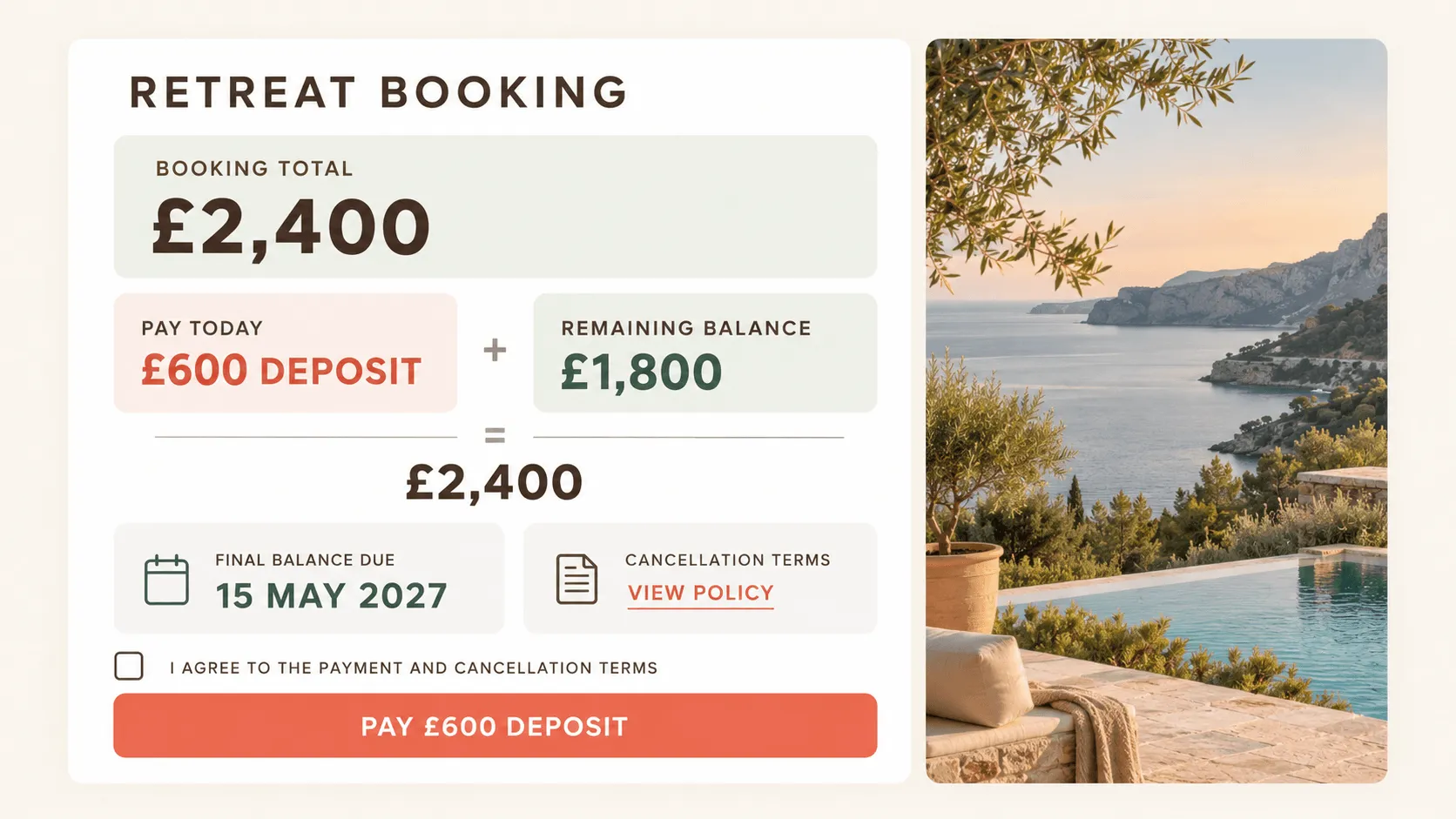
A deposit should create real booking commitment and reduce your financial exposure without being chosen from an arbitrary industry percentage. The right amount depends on the costs you take on after a guest reserves, how much money you need to commit before later instalments arrive and how your cancellation terms work.
What should the deposit cover?
Start by asking what changes financially when somebody books. You might need to reserve accommodation, commit to a venue allocation or confirm suppliers. The deposit should make sense in relation to those obligations.
That does not mean the deposit must reimburse every possible cost immediately. It means the amount should have a purpose. A host who can explain what the deposit protects is in a stronger position than one who simply copied a percentage from another retreat website.
Should a retreat deposit be refundable?
Both refundable and non-refundable deposit structures exist. What matters is that the treatment is clear before the guest pays and that it fits the wider cancellation and refund policy.
A vague statement that a deposit is “non-refundable” is not enough on its own. Guests should also understand what happens to later instalments, whether any cancellation windows apply and what happens if the host cancels the retreat. Published retreat policies use different structures, which is another reason not to assume there is one universal model.
Fixed amount vs percentage deposit
A retreat deposit can be a fixed amount or a percentage of the booking value. Each can work. A fixed amount may be easier to understand when retreat prices are similar, while a percentage naturally changes with room type or booking value.
The decision should come back to your actual financial exposure and the commitment you need from the guest. Published deposit-policy guidance shows several possible structures, including flat amounts, percentages and non-refundable deposits, rather than one required model.
Build the retreat payment plan around real deadlines
Work backwards from the final balance deadline and the dates when your own retreat costs become committed. The payment schedule should put enough money into the business before those obligations fall due, while giving guests a clear sequence of dates they can understand.
A simple structure might begin with the deposit at booking, include one or more interim instalments where appropriate and finish with the remaining balance. The spacing between those payments should reflect the retreat timeline rather than an arbitrary monthly pattern.
Also decide what happens when somebody books close to the retreat. A guest joining after an interim instalment date has already passed may need a different schedule or may need to pay the remaining balance immediately. That rule should be defined before you start taking late bookings.
Real-world policies vary. For example, one published retreat operator requires its remaining balance 21 days before the retreat and sets consequences for missed payment dates. That is an example of one operator's structure, not a benchmark every retreat should copy. Its published refund policy shows how payment deadlines can be written into the wider terms.
Keep this stage focused on the policy itself. The separate Gather guide on the retreat payment plan covers the mechanics of collecting deposits, instalments and final balances.
Set cancellation windows before writing the refund policy
Decide what happens at each cancellation stage based on the costs you can still recover at that point. Cancellation rules and refund rules are connected, but they are not the same thing. The cancellation window tells you when the guest leaves the booking. The refund rule tells you what happens to money already paid.
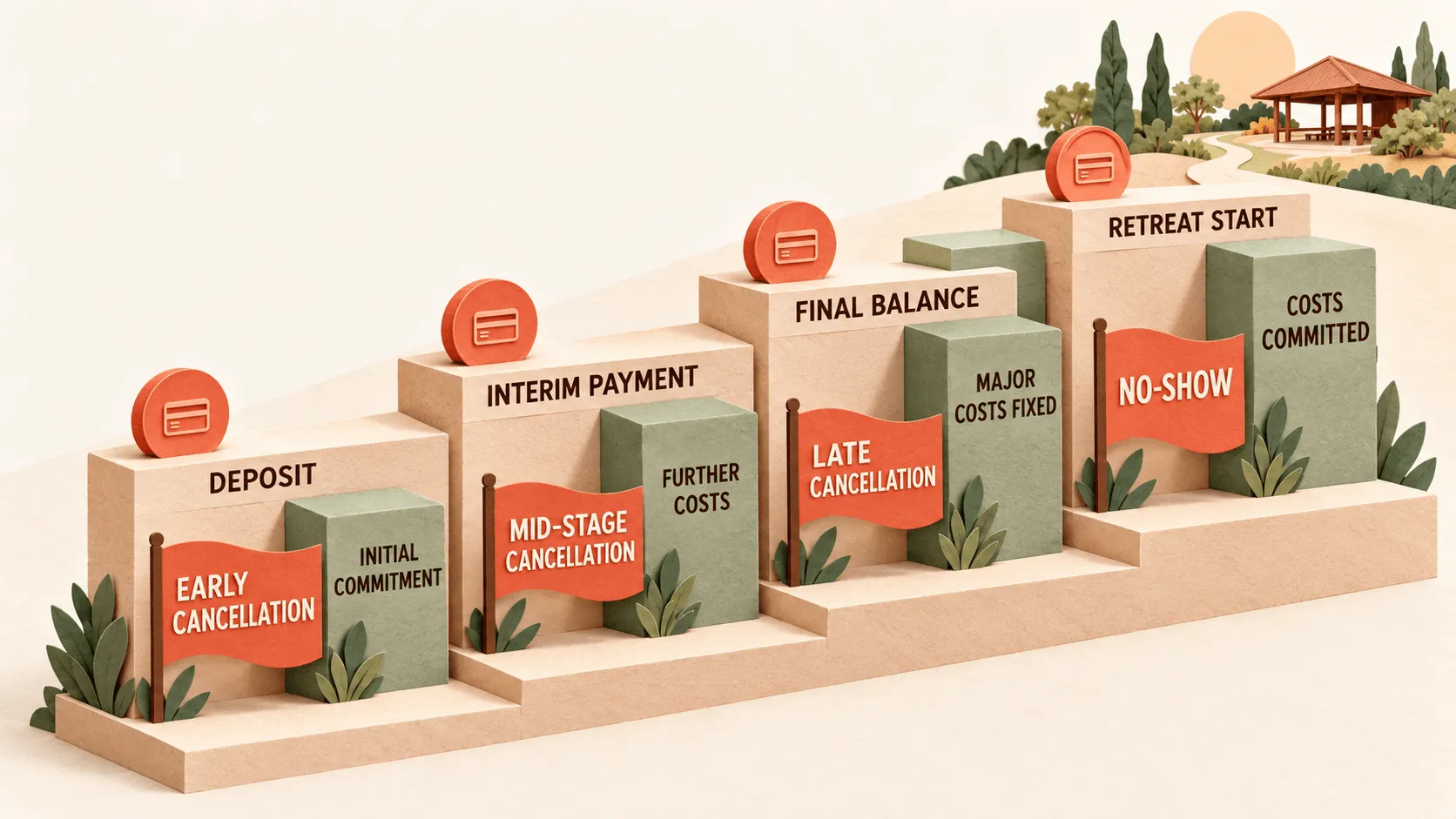
You might define an early cancellation stage while most costs are still recoverable, a middle stage after some commitments have been made and a late stage once major venue or supplier costs are fixed. You should also state what happens in the case of a no-show or a withdrawal immediately before the retreat.
The important point is not the number of days you choose. It is the relationship between those dates and your real exposure. The closer the retreat gets, the more costs are typically committed, so your policy should reflect the point at which you can and cannot recover those costs.
Different published retreat policies use different cancellation structures. For example, BookRetreats describes multiple cancellation-policy types and allows different structures rather than presenting one universal schedule. That variation is useful evidence that hosts should build terms around their own model.
Write a retreat refund policy guests can understand
State exactly what is refundable, what is not, which deadlines apply and how any refund is calculated. A guest should not have to combine several emails and checkout notes to work out what happens to their money after a cancellation.
Cover the deposit first. Then explain what happens to instalments already paid, whether partial refunds are possible and when any refund would be processed. If you offer transfers or credits, define when they are available rather than leaving them as an informal exception.
It is also important to state what happens if you cancel the retreat. That is a different situation from a guest cancellation and should not be left implicit.
Some retreat policies treat the deposit and remaining balance differently. Published cancellation terms provide an example of separate rules for deposits and later balances. Your own wording should make the same relationships easy to follow, even if your structure is different.
Keep the policy practical and readable, but remember that guest terms are contractual. Have the final wording checked for the jurisdictions where you sell your retreats and for any consumer-law requirements that apply to your business.
Put all retreat payment terms in one place
Guests should see the same deposit, payment, cancellation and refund rules wherever the booking is described. If the checkout says one thing and the confirmation email says another, even a sensible policy becomes difficult to operate.
Check the booking page, checkout, confirmation email, terms and conditions, payment reminders and guest portal. The wording does not have to be repeated in full everywhere, but the amounts, dates and consequences should never contradict each other.
Transparency also matters when a cancellation happens. Some booking platforms require the policy selected at booking to remain visible and then apply that policy to later cancellation requests. Published cancellation guidance provides one example of that approach.
This is where connected systems help. Gather retreat management software keeps bookings, payments, deposits, payment plans and guest records together. Hosts dealing with information split between payment links and spreadsheets can also read our guide to retreat booking software.
Example retreat payment policy structure
A useful way to test your policy is to map it by booking stage. For each stage, check what the guest has paid, what the business has committed, what happens if the guest cancels and how the refund treatment follows from those facts.
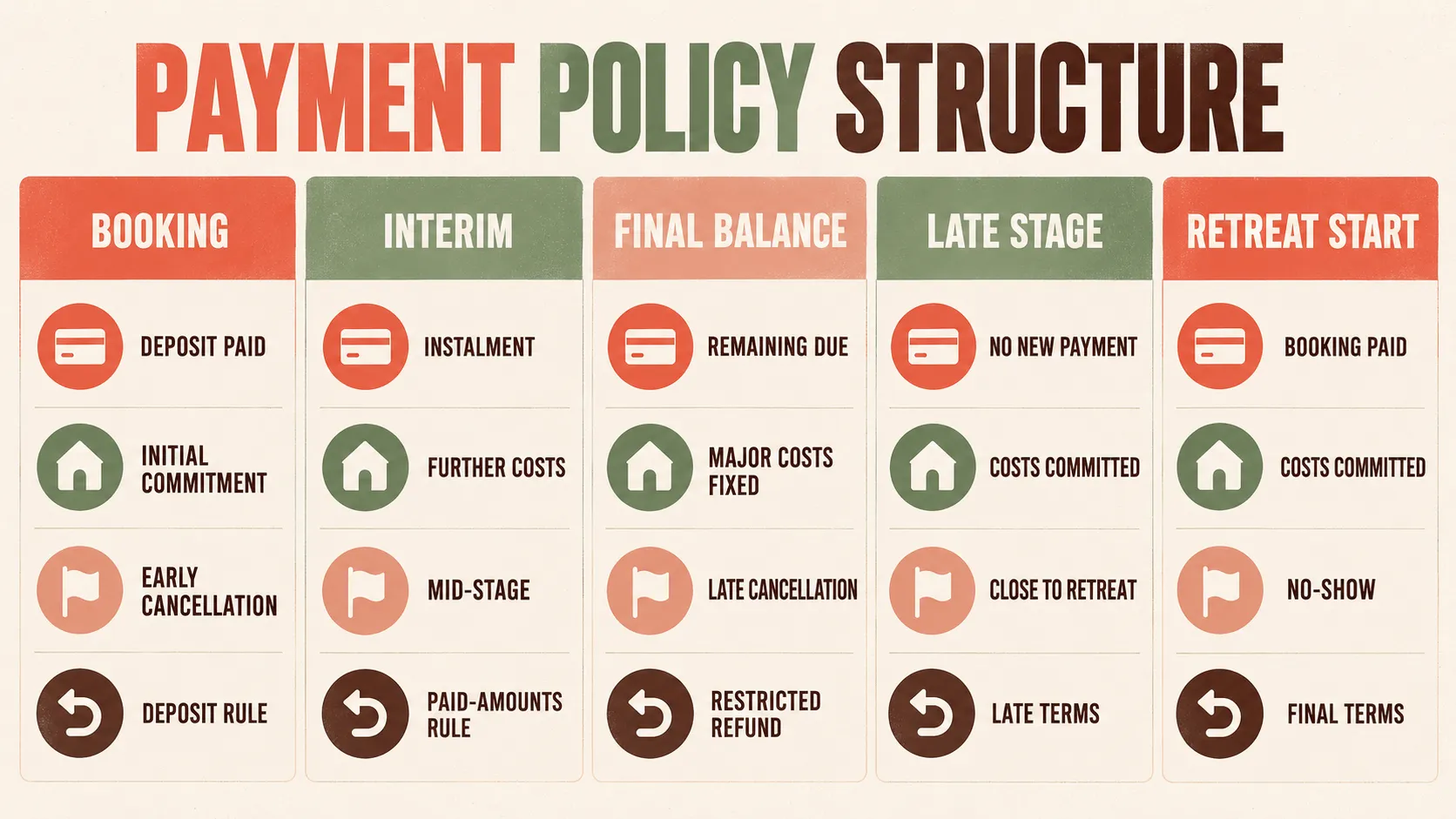
Stage | Guest Payment | Host Commitment | Cancellation Outcome | Refund Treatment |
|---|---|---|---|---|
Booking | Deposit paid | Initial venue or supplier commitment may begin | Early cancellation window | Follow the stated deposit rule |
Interim payment | Scheduled instalment | Further costs may become committed | Mid-stage cancellation | Apply the policy to amounts already paid |
Final balance deadline | Remaining balance due | Most major costs may now be committed | Late cancellation window | Refund treatment becomes more restricted if costs are no longer recoverable |
Late cancellation | Usually no new scheduled payment | Host may be carrying committed costs | Guest cancels close to retreat | Apply the published late-cancellation terms |
Retreat start / no-show | Booking already paid under agreed terms | Retreat costs are committed | No-show or withdrawal | Apply the published no-show or final-stage terms |
This is an illustrative framework, not an industry standard. Replace each stage with the actual deadlines and commitments in your own retreat business.
Common mistakes in retreat deposit and cancellation policies
The biggest mistakes usually happen when payment terms are written separately or copied from another operator without checking the financial commitments underneath them.
Choosing a deposit before checking what the venue requires from you.
Making the final balance due after major retreat costs have already become non-refundable.
Using different cancellation or refund wording across the booking page, checkout and confirmation emails.
Calling a deposit “non-refundable” without explaining what happens to later payments after cancellation.
Leaving out what happens if the host cancels the retreat.
Treating payment-plan instalments as separate from the cancellation and refund rules that apply to those payments.
Each problem comes back to the same point. Deposits, payment schedules, cancellation terms and refunds should be one policy. When one date changes, check the others too.
Manage retreat deposits and payment plans in one place
Once the policy is decided, the next challenge is running it consistently across every booking. Gather Software brings bookings, payments, deposits, payment plans, guest records and the guest portal into one branded system. It is designed for independent hosts and smaller retreat centres that have outgrown separate forms, payment links and spreadsheets. If you are comparing the operational cost of moving everything into one system, you can review our booking software pricing.
Book a call to see how your own deposit and payment workflow could work inside Gather.
Frequently Asked Questions
See where you are leaving bookings on the table
Book a call and we will tell you honestly whether Gather fits, and what to use if it does not.