
Retreat Payment Plans: How to Collect Deposits and Final Balances

A good retreat payment plan makes a booking manageable for the guest without leaving the host exposed. That means deciding three things before bookings open: how much is due as the deposit, whether there will be one or more instalments, and when the final balance must be paid. The aim is not simply to reduce the upfront price. It is to create a payment schedule that supports commitment, covers your costs and gets the full booking value collected before the retreat.
How retreat payment plans work
Most retreat payment plans follow one of three structures: full payment when the guest books, a deposit followed by one final balance, or a deposit followed by several instalments. The right structure depends on the retreat price, how far ahead guests book, your supplier commitments and how much payment tracking you are prepared to manage.
Deposit plus final balance
This is the simplest payment plan. The guest pays a deposit to secure the booking, then pays the remaining balance on one clearly defined date. It gives guests more flexibility than paying the full price upfront without creating several instalments for the host to monitor.
Deposit plus instalments
For higher-priced retreats or longer booking windows, the remaining balance can be divided across two or more scheduled payments. Each instalment needs a clear amount and due date. More stages can make the price easier to spread, but every additional stage also creates another payment that needs to be tracked.
Pay in full
Full payment at booking removes the need to collect future balances. It can be useful for lower-priced retreats or bookings made close to departure. The trade-off is a larger upfront commitment for the guest, which may not suit every retreat or booking window.
How much should a retreat deposit be?
There is no universal retreat deposit percentage. A useful starting point is the amount you need to create meaningful guest commitment while contributing towards costs that become difficult or impossible to recover. Your venue terms, supplier deposits, cancellation exposure and total retreat price matter more than copying one percentage from another host.
Start with your committed costs
Look at what becomes payable soon after a guest books. That could include accommodation commitments, venue deposits or supplier costs. Your guest deposit does not have to cover every early expense, but it should be chosen with those commitments in mind rather than treated as an arbitrary number.
Current retreat policies show how widely deposit structures can vary. The operator examples reviewed for this article included percentage-based deposits as well as fixed amounts. For example, White Dakini's published terms use a 25% deposit, while other reviewed operators use fixed deposits. That variation is a useful reminder that there is no single correct retreat deposit.
Balance conversion against commitment
A smaller deposit reduces the amount a guest needs to pay immediately, but it also leaves more of the booking value outstanding. A larger deposit secures more cash earlier, but asks for more commitment at checkout. Choose the balance that makes sense for your price point, booking window and financial exposure.
Make the deposit policy clear before checkout
Guests should know what the deposit is, what it secures and what happens next before they pay. The remaining schedule, cancellation terms and any conditions attached to the deposit should not appear as a surprise after the booking has been made.
How to build a retreat payment schedule
Build your retreat payment schedule backwards from the start date and from the dates when your own major costs become due. Then keep the number of payment stages as simple as possible. Guests should be able to look at the schedule once and understand what they pay today, what they pay later and when the booking must be fully paid.
Deposit at booking
The first payment confirms the guest's commitment and begins the schedule. Make the amount visible during the booking process, alongside the remaining balance and future due dates wherever possible.
One or more instalments
If you split the remaining balance, place instalments around meaningful dates rather than adding them simply because the system allows it. A published example from MANA Temple's retreat terms uses a $1,000 deposit, 50% of the remaining balance no later than 120 days before the retreat, then the final balance 60 days before the start date. That is one operator's structure, not a universal template.
Final payment deadline
The final payment date should give you enough time to identify a failed or missing payment and resolve it before the retreat. It should also make sense alongside your own cancellation terms and the dates when accommodation, venue and supplier balances become committed.
When should the final retreat balance be due?
Set the final retreat balance deadline early enough that you are not approaching the retreat with significant unpaid bookings. Work backwards from supplier deadlines, cancellation terms and the time you need to resolve payment problems. There is no single industry deadline that works for every retreat, so the date should reflect the risks in your own operation.
The operator examples reviewed for this article used final-balance deadlines ranging from 30 to 90 days before the retreat. White Dakini uses 30 days, another reviewed operator uses 60 days and another uses 90 days. That spread is more useful than treating one figure as the rule. Your deadline should match when your own costs and cancellation exposure become harder to reverse.
What to do with late bookings
A guest who books after one or more instalment dates have passed needs a defined rule. You can require the overdue amounts immediately, ask for full payment at booking, or compress the remaining balance across future instalments if your system supports it. Choose the rule before the situation occurs and apply it consistently.
Some retreat operators move directly to full payment for late bookings. The Way Hōm's published terms, for example, require full payment when a booking is made less than 60 days before the retreat. Other reviewed terms use a longer cut-off.
Technology can support a different approach. WeTravel documents an auto-adjust option that redistributes amounts across remaining scheduled payments. If all instalment dates have already passed, the remaining balance becomes due at checkout. The important point for a host is to decide what your own late-booking logic should be before bookings open.
Collecting retreat payments without chasing every guest
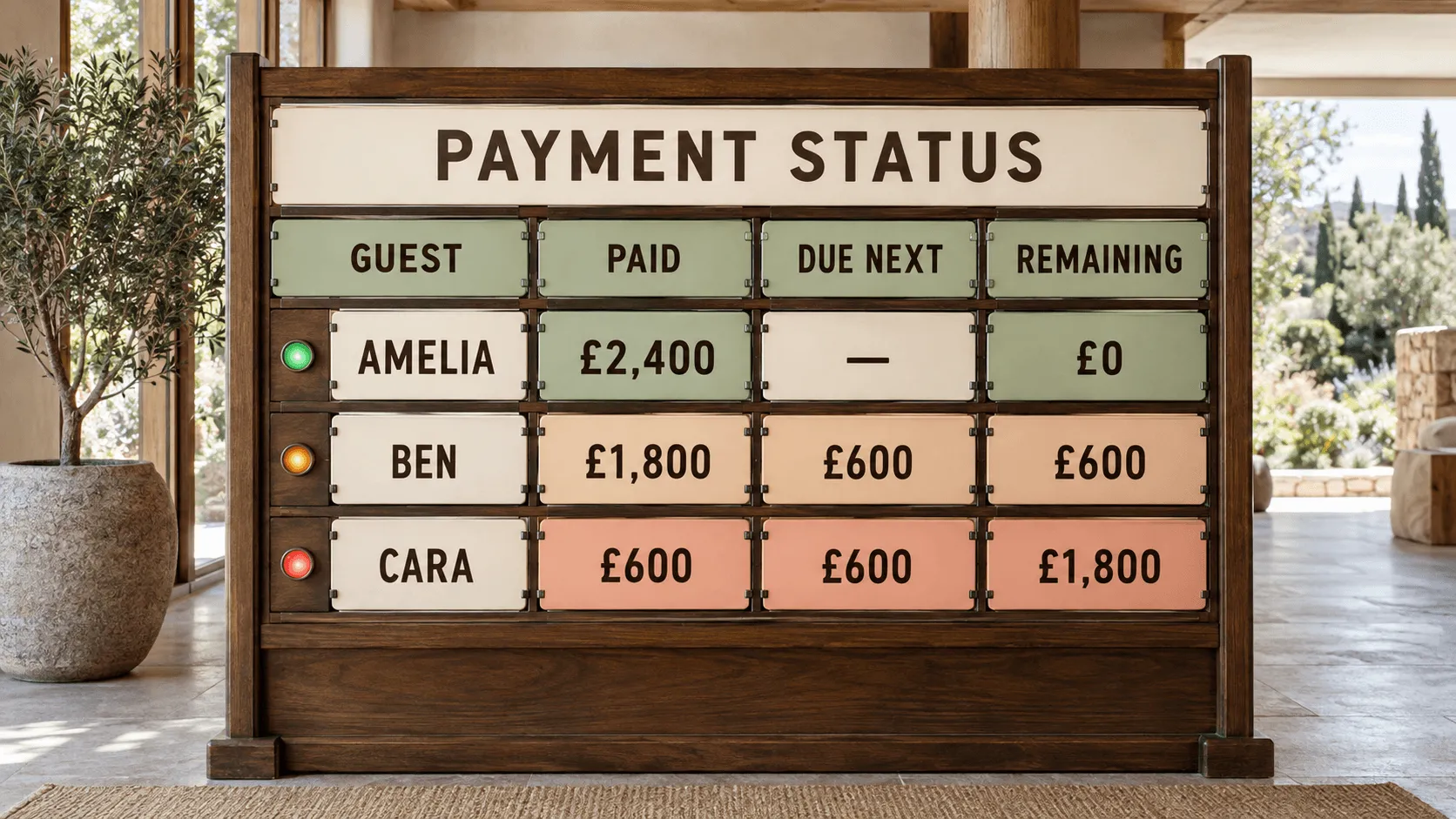
Once bookings begin, every guest record should make three things obvious: what has already been paid, what remains outstanding and when the next payment is due. When those details live across a form, separate payment links and a spreadsheet, the host has to keep reconstructing the picture manually. That is where payment plans become fragile.
Separate tools also make chasing retreat payments a recurring task. Someone has to check whether money arrived, update the spreadsheet, identify upcoming balances and message individual guests. The problem becomes more noticeable as you run more dates or offer several payment stages.
This is where retreat management software can reduce the operational load. Gather Software supports bookings, deposits, payment plans, guest balances and a guest portal in one branded system, so the payment status sits alongside the booking rather than in a separate tracking process.
Automation can also handle parts of the collection process. SquadTrip documents scheduled auto-charges, reminders, receipts and retries after unsuccessful charges. Payment-plan automation is therefore part of the broader retreat booking software decision, not simply a checkout feature.
What your retreat payment terms should tell guests
Your payment terms should tell guests the deposit amount, every instalment date, the final balance deadline, accepted payment method, cancellation terms and what happens if a scheduled payment is missed. The aim is to remove ambiguity before money changes hands, so both the host and guest know how the booking will progress.
Keep payment schedules and cancellation terms clearly connected without treating them as the same policy. Chloe Keeps Travelling's terms, for example, state that using a payment plan does not change the cancellation terms that apply to the booking. Its terms also explain that missed scheduled payments can ultimately affect the booking.
Other retreat terms similarly spell out the consequence of missing a final deadline. SEAFOLK Retreats states that its remaining balance is due 60 days before check-in and that failure to make final payment can lead to cancellation under its terms. Your own wording should reflect your actual policies and receive appropriate professional review where needed.
A simple retreat payment plan example
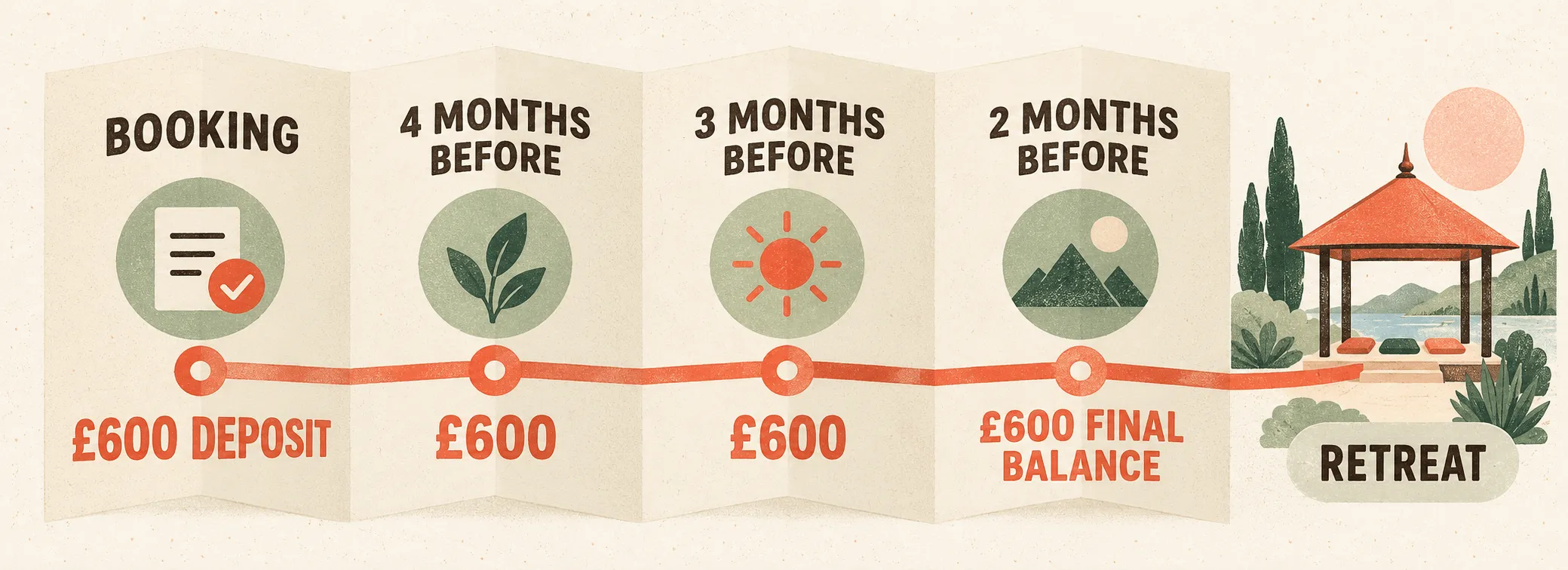
A simple example can make the sequence easier to see. The numbers below are illustrative only, not a recommended deposit percentage or industry-standard deadline. The useful part is the structure: a payment at booking, a limited number of future instalments and a final deadline that leaves the host time before the retreat.
Imagine a retreat priced at £2,400 per guest, booked several months ahead:
Payment stage | Timing | Example amount |
|---|---|---|
Deposit | At booking | £600 |
First instalment | Four months before the retreat | £600 |
Second instalment | Three months before the retreat | £600 |
Final balance | Two months before the retreat | £600 |
The same £2,400 booking could use a completely different structure. A host might choose a larger deposit and one final balance, or full payment for bookings made close to the start date. The schedule should follow the economics and booking window of the retreat rather than the example above.
Make retreat payment plans easier to run
A payment plan only works operationally when you can see what each guest has paid, what remains and what is due next without rebuilding the schedule in spreadsheets. Gather Software brings the website, booking flow, deposits, payment plans, guest balances and payment collection into one branded system. Hosts that also manage shared or private inventory can keep room choices connected to the booking. Published Gather pricing is £79 a month or £699 a year, plus 2% per booking, with USD and EUR supported. It is built for independent hosts and smaller retreat centres that have outgrown separate forms, payment links and spreadsheets.
See how your own deposit and balance workflow could work inside Gather. Book a call.
Frequently Asked Questions
See where you are leaving bookings on the table
Book a call and we will tell you honestly whether Gather fits, and what to use if it does not.